


5 Warning Signs You Should See An Orthopedic Specialist For Knee Pain
Your parent keeps rubbing their knee, wincing on the stairs, or walking less than they used to. Most knee pain settles on its own — but these 5 warning signs mean it is time to see an orthopedic specialist, not wait it out.
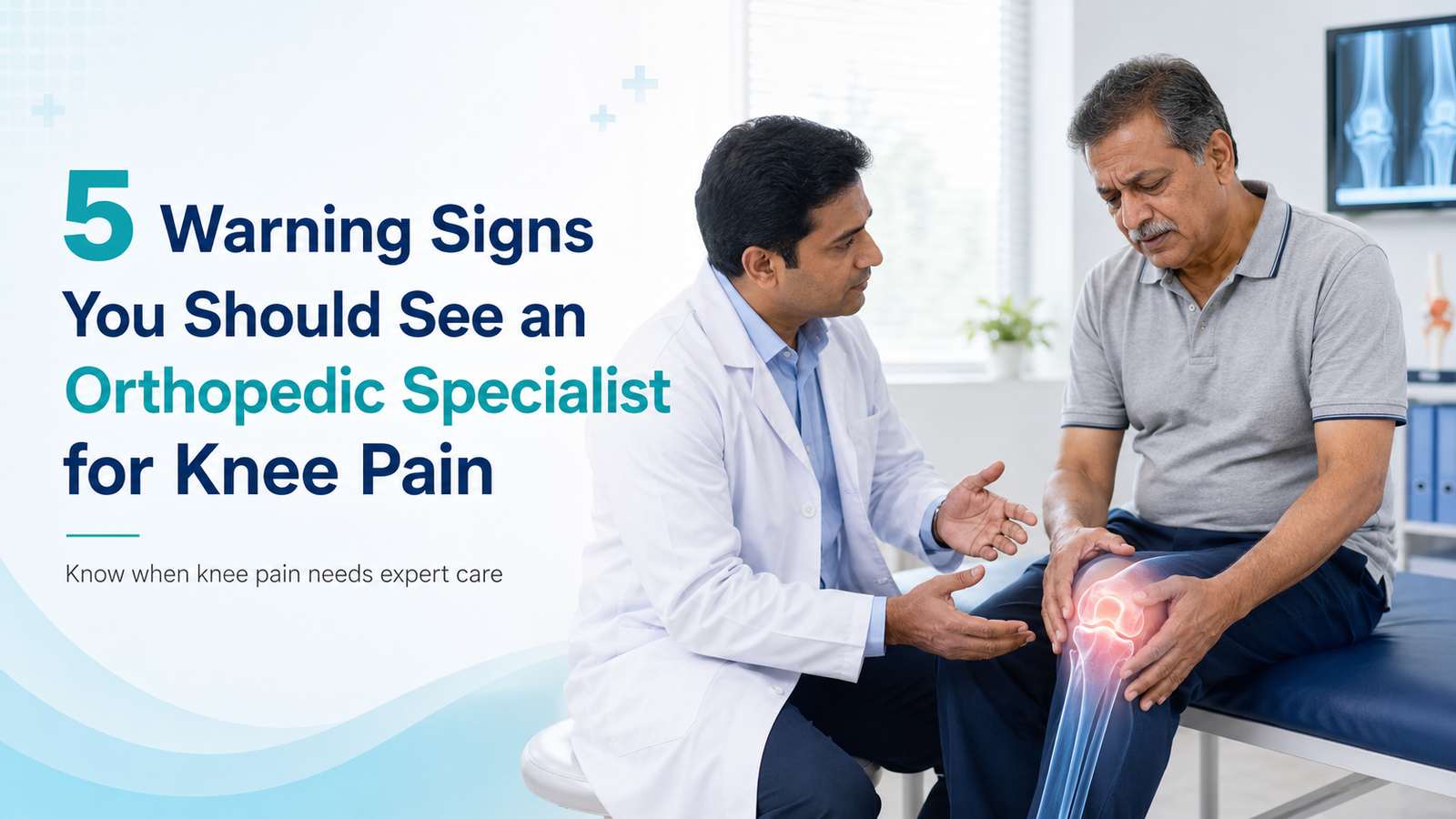
Short answer: See an orthopedic specialist for knee pain if you notice any of these 5 warning signs:
- Pain that lasts more than 2–3 weeks or keeps getting worse.
- Swelling, warmth, or redness that will not settle.
- The knee locks, catches, gives way, or buckles.
- You cannot fully bend or straighten it, or cannot put weight on it.
- Pain after a fall, twist, or injury — with a “pop” or a visibly out-of-shape knee.
🔑 Key takeaways
- Most knee pain is not serious and eases with rest, ice, and simple painkillers within a couple of weeks.
- The 5 warning signs above mean “get it checked” — they can point to arthritis, a torn ligament or cartilage, or another problem that needs a specialist.
- Age alone is not the enemy. An ageing parent’s knee pain is very treatable — but the earlier it is seen, the more options they have (often without surgery).
- A hot, swollen knee with fever, or a deformed knee after a fall, is an emergency — go to the hospital the same day.
- Start with an orthopedic doctor for a diagnosis, then follow their plan — which is often physiotherapy, medicines, or injections before any surgery.
When you watch a parent slow down — taking the stairs one at a time, skipping a walk, quietly rubbing a knee — it is hard to know when to worry. Is it just “old age,” or is something wrong? Knee pain is one of the most common complaints in India, and it is rising fast. Knee osteoarthritis (the “wear and tear” type of joint damage) affected an estimated 62 million Indians in 2019, up from about 23 million in 1990, and it is more common in women.[1]
The good news: most knee pain is not dangerous and settles with simple care. This guide helps you — the son or daughter making the calls — tell ordinary aches from the warning signs that mean it is time to see an orthopedic specialist (a bone-and-joint doctor). We will also cover when knee pain is a true emergency, and who to see first.
Sign 1: Knee pain that lasts more than 2–3 weeks (or keeps getting worse)
Pain that won’t go away — or grows
Everyday knee pain from a long walk or a minor knock should ease within a week or two of rest, ice, and over-the-counter painkillers. If the pain lasts longer than 2–3 weeks, or slowly gets worse instead of better, it is time to see an orthopedic specialist. Most doctors use a two-week mark as the point to get knee pain checked.[2]
Why it matters: pain that lingers often means the joint itself is involved — early arthritis, cartilage wear, or a small tear — and these respond far better when treated early.
Sign 2: Swelling, warmth, or redness that will not settle
A swollen, warm, or red knee
Some puffiness after activity is normal. But swelling that does not go down with rest, or a knee that feels warm and looks red, is a sign of inflammation inside the joint and should be checked.[3] If one knee suddenly looks much bigger than the other, that is a clear reason to book a visit.
Why it matters: lasting swelling can point to arthritis, a build-up of fluid in the joint, or gout. Warmth and redness with fever can mean a joint infection — see the emergency box below.
Sign 3: The knee locks, catches, gives way, or buckles
A knee you can’t trust
If the knee locks or catches when bending, or suddenly “gives way” and feels like it might buckle under weight, see an orthopedic specialist. These “mechanical” symptoms suggest something inside the joint — like torn cartilage (a meniscus tear) or a loose fragment — is getting in the way, or that a ligament is not holding the joint steady.[3]
Why it matters: for an older parent, a knee that gives way is also a fall risk. Getting it assessed protects them from a much worse injury like a hip fracture.
Sign 4: You cannot fully bend or straighten it — or cannot bear weight
Losing movement or the ability to walk
If your parent cannot fully straighten or bend the knee, or the pain stops them from standing or walking on that leg, an orthopedic specialist should see them. A lasting drop in how far the knee moves — especially for more than a day — needs a proper look.[3] Limping to avoid pain counts too.
Why it matters: stiffness and loss of movement can mean advanced arthritis or a mechanical block. Being unable to bear weight can signal a serious ligament tear or even a fracture.
Sign 5: Knee pain after a fall, twist, or injury (a “pop” or a deformed knee)
Pain that follows an accident
Any knee pain that starts after a fall, a twist, a sports injury, or a road accident should be checked by an orthopedic specialist. Warning signs after an injury include a “pop” sound at the moment it happened, fast swelling within hours, severe pain, or a knee that looks out of shape.[4]
Why it matters: injuries can tear a ligament (like the ACL) or the meniscus, or break a bone. A visibly deformed knee after a fall is an emergency (see below). For older adults, even a simple fall can cause a fracture that needs quick treatment.
🚨 When knee pain is a medical emergency — go the same day
Do not wait for an OPD appointment. Go to a hospital emergency department right away if your parent has:
- A hot, red, very swollen knee with fever or chills — this can be a joint infection (septic arthritis), which is urgent.
- A knee that looks deformed or out of place after a fall or accident — a possible fracture or dislocation.
- Severe pain and total inability to move or bear weight after an injury.
- Sudden calf swelling, redness, or breathlessness along with knee pain — this needs urgent checking.
Aditya Hospital runs a 24×7 emergency, trauma and ambulance service. ⚠️ Verify emergency & ambulance details.
Noticed any of these signs in a parent’s knee? Meet the orthopaedics team at Aditya Hospital, Rewari for a clear diagnosis and an honest plan.
Book an OPD appointmentHow long is “too long” to wait with knee pain?
A simple way to think about timing:
- 0–3 days after a minor knock: rest, ice, and a simple painkiller are usually fine. Watch how it settles.
- Up to 2 weeks: if it is slowly improving, keep resting and go easy. If it is not improving at all, plan a visit.
- More than 2–3 weeks: see an orthopedic specialist — this is the point most doctors recommend getting knee pain checked.[2]
- Any time — don’t wait: if there is severe pain, a deformed knee, fever with a hot swollen joint, or a knee that gives way. These need same-day care.
Should a parent see an orthopedic doctor, a physiotherapist, or the family doctor?
For knee pain with any warning sign, start with an orthopedic specialist to get a diagnosis first. They examine the knee, order an X-ray or MRI if needed, and find the cause. Only then can the right treatment be chosen.
Here is the simple difference:
| Who | What they do | Best for |
|---|---|---|
| Family / general doctor | First check, basic advice, refers you on | Mild, short-lived knee pain with no warning signs |
| Orthopedic specialist | Diagnoses the cause (bones, joints, ligaments); orders imaging; plans treatment or surgery | Any warning sign, injury, or pain lasting 2–3 weeks+ |
| Physiotherapist | Guided exercises to build strength and movement | Recovery after the specialist has diagnosed the problem |
Most knee pain does not need surgery — the majority is managed with physiotherapy, medicines, weight support, and lifestyle changes. But that plan works best when an orthopedic doctor has first confirmed what is wrong.[5]
Is it arthritis or a torn meniscus? A quick self-check
You cannot diagnose a knee at home — only a doctor can. But these patterns help you understand what your parent might be feeling before the visit.
| Clue | More like osteoarthritis | More like a meniscus / ligament tear |
|---|---|---|
| How it started | Slowly, over months or years | Suddenly, often after a twist or fall |
| Who it affects | Usually older adults | Any age, common after sports or accidents |
| Main feeling | Stiffness & ache, worse in the morning or after rest | Sharp pain, catching, or the knee giving way |
| Stairs & squatting | Gradual difficulty over time | Sudden pain or locking |
Both are common and both are treatable — which is exactly why a specialist’s opinion matters.[6]
What will the orthopedic specialist do at the visit?
Knowing what to expect makes the visit less stressful for an older parent:
- Talk and examine: the doctor asks about the pain and gently checks the knee’s movement, stability, and swelling.
- Imaging if needed: an X-ray shows the bones and joint space; an MRI shows ligaments and cartilage (the meniscus) when a tear is suspected.
- A step-by-step plan: most knees start with non-surgical care — physiotherapy, medicines, injections, a knee support, or weight advice.
- Surgery only if truly needed: options like arthroscopy (keyhole knee surgery) or, for badly worn joints, partial or total knee replacement are considered only when simpler steps are not enough.
Why families across Haryana, NCR & Rajasthan choose Aditya Hospital, Rewari
Aditya Hospital is a trusted multi-specialty hospital in Rewari, serving families from across Haryana, Delhi NCR, and nearby Rajasthan. For knee and joint pain, what many families value is having everything in one place:
- An experienced orthopaedics team for arthritis, sports injuries, ligament tears, fractures, and joint replacement.
- Knee replacement, arthroscopy, and ACL/PCL reconstruction with modular operation theatres and HD arthroscopy equipment.
- In-house digital X-ray, imaging, and physiotherapy, plus 24×7 emergency and trauma support for a fall or injury.
- Ayushman Bharat and Haryana government health schemes accepted, with a TPA/insurance desk to guide you.
- A “Har Ek Jaan Anmol” (every life is precious) approach — honest advice, and surgery only when it is truly needed.
The simplest first step is an OPD conversation. Bring your parent’s reports and any old X-rays, describe the warning signs, and get a clear opinion on what is happening and what to do next.
Frequently asked questions
When should I see an orthopedic specialist for knee pain?
See an orthopedic specialist if knee pain lasts more than 2–3 weeks or keeps getting worse, if there is swelling, warmth or redness that will not settle, if the knee locks or gives way, if you cannot fully bend, straighten, or bear weight, or if the pain started after a fall or injury. A hot swollen knee with fever, or a deformed knee after a fall, needs same-day emergency care.
How long is too long to have knee pain before seeing a doctor?
Most doctors suggest getting knee pain checked if it lasts longer than two to three weeks, or if it is not improving with rest, ice and simple painkillers. Do not wait at all if there is severe pain, a deformed knee, fever with a hot swollen joint, or a knee that gives way.
Is knee pain in older adults just normal ageing?
Not always. Knee pain is common with age, often from osteoarthritis, but it is not something to simply accept. It is very treatable — usually with physiotherapy, medicines, and lifestyle steps, and only sometimes with surgery. Seeing an orthopedic specialist early gives an ageing parent more and gentler options.
Should I see an orthopedic doctor or a physiotherapist for knee pain?
Start with an orthopedic doctor to find out what is causing the pain. Physiotherapy is very effective, but it works best once the specialist has diagnosed the problem and recommended the right exercises. Around 80% of joint and muscle pain does not need surgery — but the correct plan depends on the correct diagnosis first.
What does it mean when a knee locks or gives way?
A knee that locks or catches may have torn cartilage (a meniscus tear) or a loose fragment inside the joint. A knee that gives way or buckles can mean a ligament is not holding it steady. Both should be checked by an orthopedic specialist, and for older adults they also raise the risk of a fall.
Does Ayushman Bharat cover knee treatment and surgery?
Many orthopaedic treatments, including knee replacement, are listed under Ayushman Bharat (PM-JAY) at empanelled hospitals. Check your eligibility and the hospital’s empanelment at the TPA/insurance desk before admission. ⚠️ Confirm Aditya Hospital’s empanelment status and covered packages.
Will I need surgery for knee pain?
Usually not. Most knee pain is managed without surgery — through physiotherapy, medicines, injections, knee supports, and weight management. Surgery such as arthroscopy or knee replacement is considered only when simpler treatments have not worked or the joint is badly damaged. A good orthopedic specialist recommends surgery only when it is truly needed.
Worried About a Parent’s Knee? Get It Checked Early.
Bring their reports and old X-rays for a clear diagnosis and an honest plan — from physiotherapy and medicines to surgery only if it is truly needed, with Ayushman Bharat and insurance support.
OPD: Mon–Sun, 10 am – 7 pm · Emergency & ambulance: 24×7
A-Block, Suncity, HUDA Bypass, Rewari, Haryana
Sources & references
- Burden of knee osteoarthritis in India (prevalence rising from ~23M in 1990 to ~62M in 2019; higher in women), GBD-based analyses, NCBI/PMC. ncbi.nlm.nih.gov — ⚠️ verify exact figures.
- When to see a doctor for knee pain (two-week guidance), Hospital for Special Surgery patient education. hss.edu — ⚠️ verify.
- Warning signs of serious knee problems — swelling, locking, instability, loss of motion, clinic patient-education sources. ⚠️ Verify.
- Knee injury signs needing specialist review (pop, rapid swelling, deformity), orthopaedic patient-education sources. ⚠️ Verify.
- Most joint and muscle pain is managed without surgery (~80%), orthopaedic vs physiotherapy guidance. ⚠️ Verify.
- Knee pain causes — osteoarthritis vs meniscus tear, Cleveland Clinic. my.clevelandclinic.org
- Ayushman Bharat (PM-JAY), National Health Authority. pmjay.gov.in — ⚠️ verify covered packages & empanelment.
Last updated: 1 August 2026. ⚠️ Confirm publish/updated dates and all clinical figures before publishing.


