


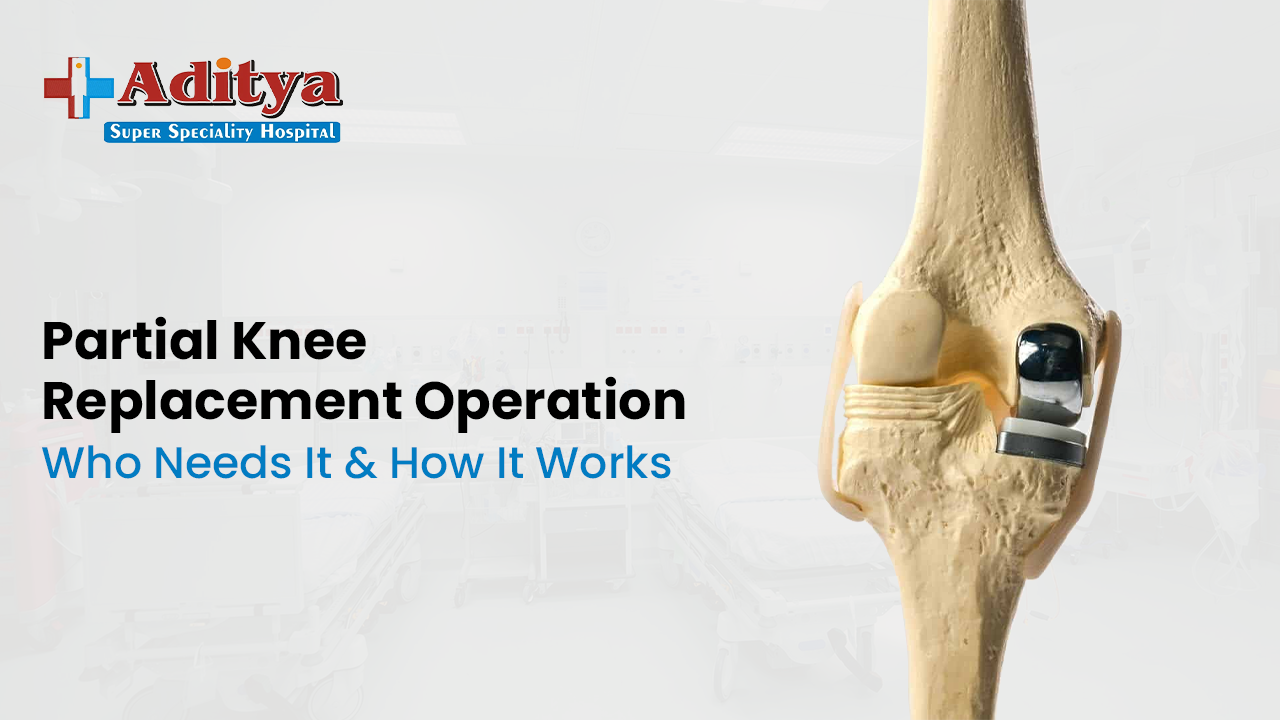
Is Your Knee Pain Trying to Tell You Something?
Knee pain quietly takes over your life.
You avoid the stairs. Sitting cross-legged has become impossible. Some nights, the pain wakes you up.
If this sounds familiar, you are not alone. And you may not need as much surgery as you fear.
Try these three simple checks first.
The One-Finger Test: Point one finger at the spot that hurts most. Is it the inner side of your knee? Or the outer side? If you can point to an exact spot rather than saying "the whole knee hurts," the damage may be limited to one area. That is exactly what partial knee replacement treats.
The Mobility Check: Can you still straighten your leg? Can you walk, even if it is painful? If yes, your knee still has functional range, a good sign.
The Treatment History Check: Have you tried physiotherapy, medication, or injections? Did the relief not last? If conservative treatments have stopped working, a surgical solution may be the right next step.
If you nodded through all three, keep reading. You may be a stronger candidate for partial knee replacement than you think, and our orthopaedic team at Aditya Hospital, Rewari, is here to help you find out.

What Is Partial Knee Replacement?
Most people assume knee replacement means replacing the entire knee. That is not always the case.
Your knee is divided into three compartments:
- The inner side (medial)
- The outer side (lateral)
- The front (patellofemoral)
In many patients, arthritis damages only one of these compartments. The other two remain perfectly healthy.
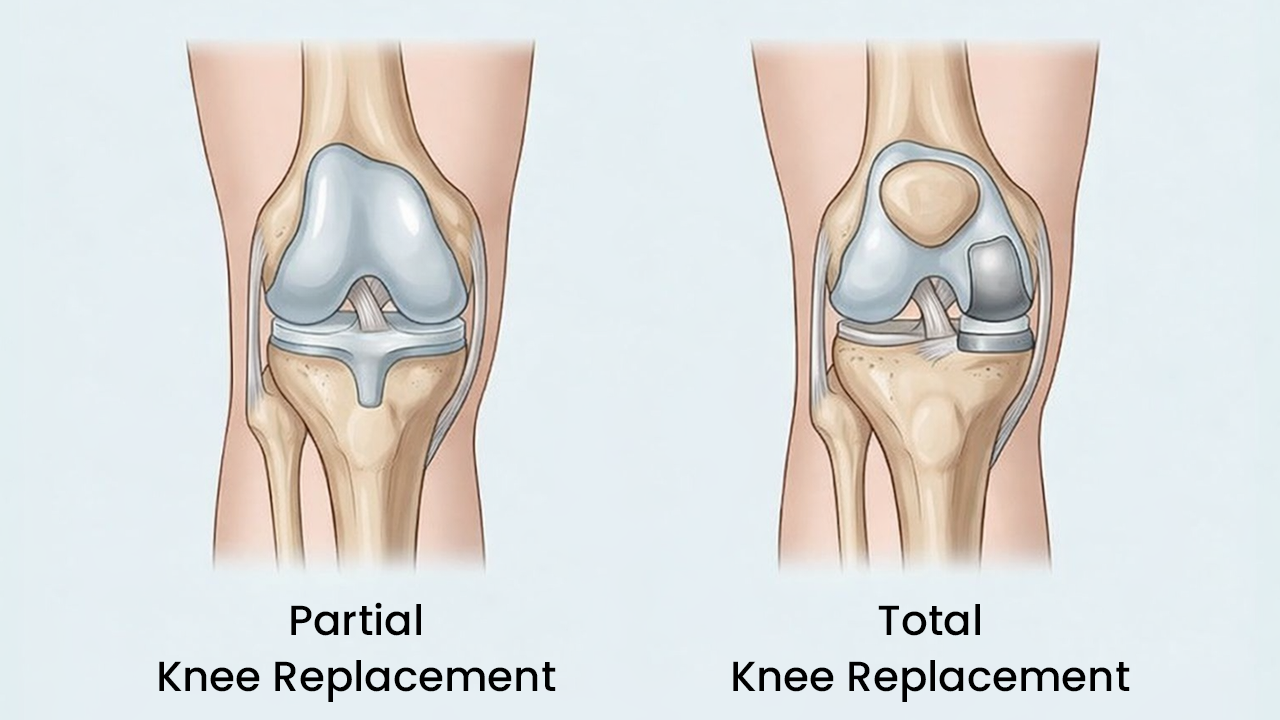
A partial knee replacement procedure targets only the damaged compartment. The healthy bone, cartilage, and ligaments around it are left completely untouched.
Here is what that means for you:
- 75% of your natural bone is preserved
- Your ACL and PCL ligaments stay intact
- Your knee continues to feel and move like your own, just without the pain
This is the fundamental difference between partial and total knee replacement. Total replacement removes everything. Partial replacement removes only what needs to go.
Less removed. More preserved. Faster recovery.
Who Needs a Partial Knee Replacement Operation?
Not every knee pain patient qualifies. A partial knee replacement operation is recommended for a specific group of patients.
You may be a good candidate if:
- Your X-ray or CT scan confirms arthritis in one compartment only
- Your ACL and other ligaments are intact
- You have tried physiotherapy, medication, and injections without lasting relief
- You can still straighten your leg fully
You may not be a candidate if:
- You have rheumatoid or inflammatory arthritis
- The damage has spread across more than one compartment
- You are significantly overweight
A note on age: Age alone is not a deciding factor. We have treated patients in their 50s, 60s, and 70s. What matters most is the extent of damage, not the number on your birth certificate.
The truth: Not every patient who walks into Aditya Hospital needs a partial knee replacement operation. Some need total knee replacement. Some need physiotherapy. Our job is to assess you thoroughly and recommend what is right for your knee, nothing more, nothing less.
The right treatment starts with the right diagnosis.
The Partial Knee Replacement Procedure: Step by Step
Many patients worry about surgery. Understanding the process can help in removing the fear. And if you still have questions after reading, we are just a consultation away. Book an appointment now! We are here to assist you.
Here’s a look at the partial knee replacement procedure at Aditya Hospital:
Step 1: Pre-Surgical Planning: Before the operation begins, Dr. Akash Yadav uses advanced CT Scan imaging to study your knee in detail. Every patient's knee is different. This step ensures the implant is placed with precision, personalised to your anatomy rather than a standard template.
Step 2: Anaesthesia: You will be given either general or spinal anaesthesia. Our team uses a multimodal analgesic approach that combines nerve blocks and local anaesthesia. This means you wake up alert and comfortable, without heavy sedation.
Step 3: The Incision: The incision is 3-4 inches long. Compare that to the 8–10 inch cut required for a total knee replacement. A smaller cut means less damage to the surrounding tissue.
Step 4: Removing Only What Is Damaged: Access only the damaged compartment. The surgeon removes only the worn cartilage and a small amount of bone from that area. Everything else, healthy bone, cartilage, and ligaments, is left untouched.
Step 5: Fitting the Implant: A precisely sized implant is fitted into the cleared compartment. It is secured in place and tested for movement and alignment before closing.
Step 6: Closing: The incision is closed. The entire procedure takes approximately 1-2 hours.

The Recovery Pathway
One of the biggest fears patients have is recovery. How long will I be off my feet? Will I need help for months?
With partial knee replacement, recovery is faster than most people expect.
Going Home: Most patients at Aditya Hospital return home sooner than they anticipate. Because less bone and tissue are disturbed during the operation, your body has less to heal.
Pain Management: Thanks to our multimodal analgesia approach, most patients wake up from surgery with manageable discomfort, not the intense pain they feared. No heavy narcotics. No groggy recovery room hours. You are alert and mobile much sooner.
Physiotherapy: Recovery does not stop when you leave the operating theatre. Our in-house physiotherapy team at Aditya Hospital takes over from there. You do not need to travel elsewhere. Everything you need for a full recovery is right here in Rewari.
Your Recovery Timeline
Week | What to Expect |
Week 1 | Walking with support at home |
Week 2-3 | Swelling reduces, you are off the walker |
Week 4 | Light daily activities resume |
Week 6 | Driving, gentle movement |
Week 8-12 | Back to walking, farming, and climbing stairs |
One Important Note: Every patient recovers at their own pace. Your age, overall health, and commitment to physiotherapy all play a role. Our team will guide you at every step.
What Makes Aditya Hospital Different?
There are many places to get knee surgery. Here is why patients from Haryana, Rajasthan, and Delhi NCR choose Aditya Hospital.
Specialist Orthopaedic Care Close to Home
You do not need to travel to Delhi or Gurgaon for quality knee surgery. Dr. Akash Yadav brings specialist orthopaedic expertise right here in Rewari. Same quality care. No long-distance travel. No unfamiliar city.
Advanced In-House Imaging
Our CT Scan facility is available in-house. Pre-surgical planning happens here, no running between hospitals for scans and reports.
In-House Physiotherapy
Your recovery happens under one roof. Our physiotherapy team works alongside Dr. Akash Yadav to ensure your rehabilitation is consistent, monitored, and effective.
A Hospital That Puts Patients First
At Aditya Hospital, we do not recommend surgery unless it is truly needed. We will assess your knee honestly and tell you exactly what you need, even if that means no surgery.
This is what "Har Ek Jaan Anmol" means to us in practice. Every life is precious. Every patient deserves the truth.
24×7 Support
From your first consultation to your last physiotherapy session, our team is available around the clock.
Not sure if partial knee replacement is right for you?
Consult our specialist at Aditya Hospital for an honest opinion.
Book an Appointment Now!!
Frequently Asked Questions
Q1. What makes Aditya Hospital the best knee replacement hospital in Haryana?
We have experienced orthopedic surgeons, advanced technology, and a patient-first approach. Thousands of patients across Rewari and NCR trust us for safe knee replacement surgery.
Q2. How do I know if I need knee replacement surgery?
If knee pain affects your daily life and other treatments haven't helped, surgery may be the right option. Our surgeons will evaluate and guide you.
Q3. How long does knee replacement surgery take?
The procedure typically takes 1 to 2 hours. It depends on the type and complexity of your surgery.
Q4. What is the recovery time after knee replacement surgery in Haryana?
Most patients start walking within a day or two. Full recovery takes around 6 to 12 weeks.
Q5. Is knee replacement surgery painful?
Some discomfort after surgery is normal. It is manageable with medication and reduces as you heal.
Q6. Is knee replacement surgery covered under insurance?
Yes, most insurance providers cover knee replacement surgery. Our team assists with all insurance coordination.


